<?xml version="1.0" encoding="utf-8"?><feed xmlns="http://www.w3.org/2005/Atom" ><generator uri="https://jekyllrb.com/" version="3.10.0">Jekyll</generator><link href="https://krzkot.com/feed.xml" rel="self" type="application/atom+xml" /><link href="https://krzkot.com/" rel="alternate" type="text/html" /><updated>2026-09-01T19:39:57+02:00</updated><id>https://krzkot.com/feed.xml</id><title type="html">Krzysztof Kotysz</title><subtitle>Research and software engineer building data pipelines, distributed systems and scientific instrumentation.</subtitle><author><name>Krzysztof Kotysz</name></author><entry><title type="html">Słowo Analyzer: a WordleBot-lite for Polish Wordle</title><link href="https://krzkot.com/blog/technology/slowo-analyzer/" rel="alternate" type="text/html" title="Słowo Analyzer: a WordleBot-lite for Polish Wordle" /><published>2026-07-01T12:00:00+02:00</published><updated>2026-07-01T12:00:00+02:00</updated><id>https://krzkot.com/blog/technology/slowo-analyzer</id><content type="html" xml:base="https://krzkot.com/blog/technology/slowo-analyzer/"><![CDATA[<p>I have added a new little project to this site: <strong>Słowo Analyzer</strong>, a browser-based assistant for analysing strategies in the Polish version of Wordle.</p>

<p><a href="/slowo-analyzer/" class="btn btn--primary">Open Słowo Analyzer</a>
<a href="https://github.com/kkotysz/slowo-analyzer" class="btn btn--info">View the source on GitHub</a></p>

<h2 id="what-does-it-do">What does it do?</h2>

<p>The analyzer can be used in two ways:</p>

<ul>
  <li><strong>Simulation with a known answer</strong> automatically calculates the familiar green, yellow and grey tiles after each guess.</li>
  <li><strong>Manual analysis</strong> lets you reproduce a game in progress by setting the tile colours yourself.</li>
</ul>

<p>After every move, the app filters the remaining candidates and ranks possible next guesses. The ranking includes entropy, worst-case and average bucket size, the chance of an immediate hit and the estimated average number of moves required to finish.</p>

<p>A <em>bucket</em> is simply a group of answers that would produce the same colour pattern for a given guess. A good move should split the remaining words into small buckets, making the next decision easier even when it does not hit the answer immediately.</p>

<h2 id="explore-strategies">Explore strategies</h2>

<p>The game history shows how quickly each guess reduced the candidate list. You can return to an earlier move and try another path without rebuilding the whole game.</p>

<p>There is also a starting-word solver. Give it an opening word and a move limit, and it will test the resulting strategy against the answer dictionary. The histogram shows how many games are solved in one, two, three or more attempts.</p>

<p>The dictionary combines five-letter forms from <strong>SJP.PL</strong> with the <strong>KWJP100</strong> frequency lists and morphological data from <strong>PoliMorf</strong>. A filter hides unlikely inflected forms by default, while keeping them available when needed.</p>

<h2 id="built-for-the-browser">Built for the browser</h2>

<p>Słowo Analyzer is a static <strong>React</strong> and <strong>TypeScript</strong> application built with <strong>Vite</strong>. Ranking and solver calculations run in a Web Worker, so the interface remains responsive while more expensive strategies are evaluated. The app stores its dictionary cache and preferences locally and can work offline after the first visit.</p>

<p>Everything runs in the browser—there is no account, no backend and no game data sent to a server.</p>

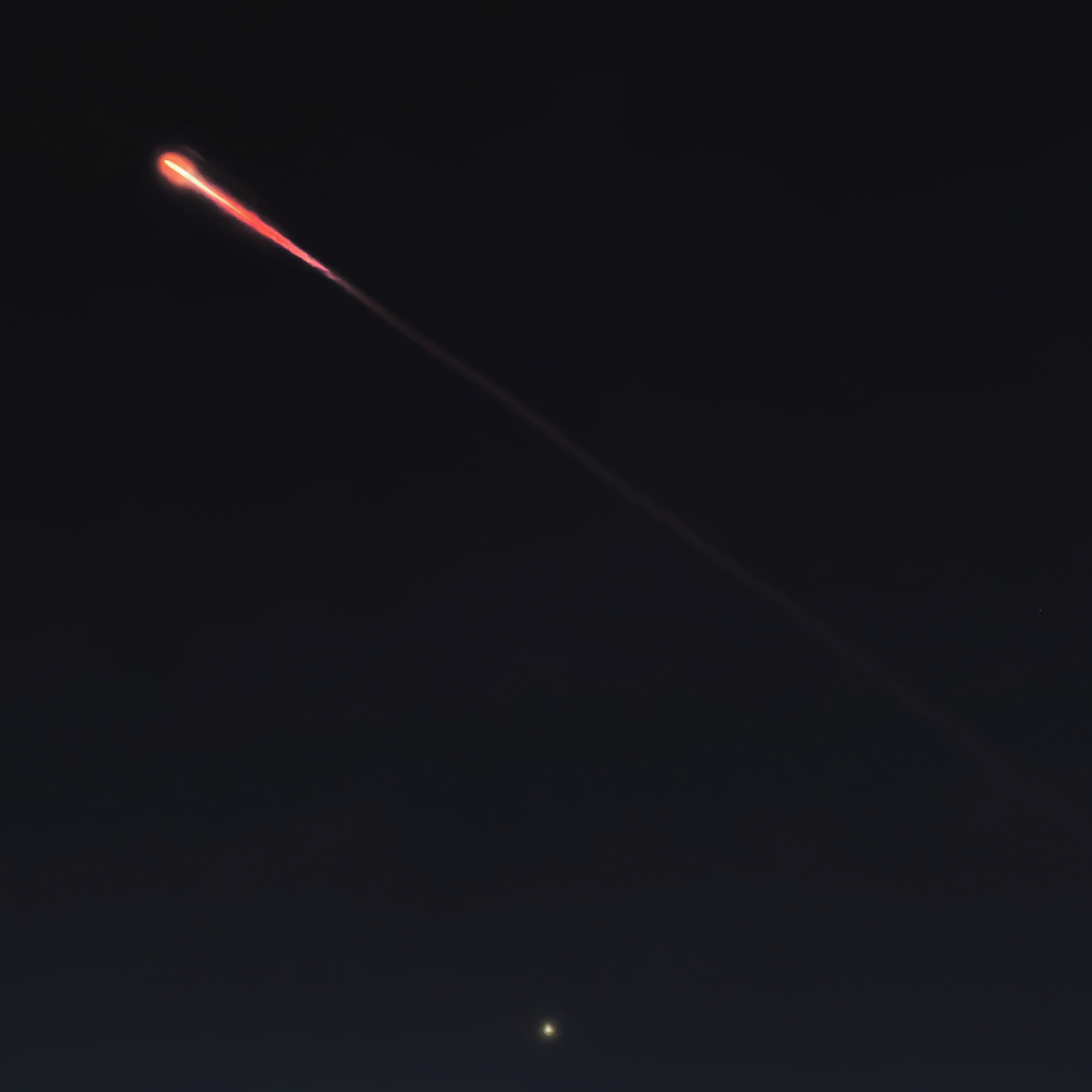
<p><a href="/slowo-analyzer/" class="btn btn--primary">Try Słowo Analyzer</a></p>]]></content><author><name>Krzysztof Kotysz</name></author><category term="blog" /><category term="technology" /><category term="slowo" /><category term="wordle" /><category term="solver" /><category term="react" /><category term="typescript" /><category term="pwa" /><summary type="html"><![CDATA[I have added a new little project to this site: Słowo Analyzer, a browser-based assistant for analysing strategies in the Polish version of Wordle.]]></summary></entry><entry><title type="html">Starlink Group 11-10 Launch from Vandenberg: February 10, 2025</title><link href="https://krzkot.com/blog/astronomy/starlink/" rel="alternate" type="text/html" title="Starlink Group 11-10 Launch from Vandenberg: February 10, 2025" /><published>2025-02-11T17:00:00+01:00</published><updated>2025-02-11T17:00:00+01:00</updated><id>https://krzkot.com/blog/astronomy/starlink</id><content type="html" xml:base="https://krzkot.com/blog/astronomy/starlink/"><![CDATA[<p>On <strong>February 10th, 2025</strong>, I had the thrilling opportunity to witness and photograph the <strong>Starlink Group 11-10</strong> launch from <strong>Space Launch Complex 4E</strong> at <a href="https://www.spacelaunchschedule.com/category/vandenberg-sfb/">Vandenberg Space Force Base</a>. This mission carried a <strong>batch of 23 satellites</strong> into <strong>Low Earth Orbit</strong>—another milestone in <strong>SpaceX’s</strong> ever-growing “mega-constellation,” which aims to provide global, space-based internet service.</p>

<h3 id="mission-details">Mission Details</h3>

<ul>
  <li><strong>Mission</strong>: Starlink Group 11-10</li>
  <li><strong>Type</strong>: Communications</li>
  <li><strong>Orbit</strong>: Low Earth Orbit</li>
  <li><strong>Launch Cost</strong>: $52,000,000</li>
  <li><strong>Launch Time</strong>: February 10, 2025, at 6:09 PM PST (February 11, 2025, at 3:09 AM CET)</li>
  <li><a href="https://www.starlink.com">Learn more about the Starlink mission</a></li>
</ul>

<p><a href="/assets/images/starlink_1.jpg"><img src="/assets/images/starlink_1.jpg" alt="Starlink launch trail" /></a>
<em>Starlink rocket ascending through the night sky, with Venus visible at the bottom.</em></p>

<p>From Goleta, located roughly 90 kilometers (60 miles) southeast of Vandenberg, the view was spectacular. In the first photo, you’ll notice the dramatic <strong>fiery exhaust trail</strong> cutting across the night sky. That small glowing point beneath the path of the rocket is Venus—providing a nice visual reference for just how bright this launch was.</p>

<h3 id="location">Location</h3>

<ul>
  <li><strong>Space Launch Complex 4E</strong>, Vandenberg SFB, CA, USA<br />
<a href="https://www.spacelaunchschedule.com/spaceport/vandenberg/">Find the best place to watch the launch from Vandenberg</a></li>
</ul>

<p>Space Launch Complex 4E has witnessed <strong>181</strong> rockets lift off—every one of those an orbital launch attempt. Meanwhile, Vandenberg Space Force Base itself (established in 1941) has hosted <strong>793</strong> rocket launches. Originally built for military and missile testing, Vandenberg also supports <strong>civil</strong> and <strong>commercial</strong> space endeavors, including those by NASA and SpaceX. The base is operated by the United States Space Force’s <strong>Space Launch Delta 30</strong>, which manages the Western Range for space launches.</p>

<p><a href="/assets/images/starlink_2.jpg"><img src="/assets/images/starlink_2.jpg" alt="Close-up of rocket exhaust" /></a>
<em>Closer look at the rocket exhaust plume and nose cone, highlighting the intense heat and glow.</em></p>

<p>In the second image, you can see the <strong>glowing rocket plume</strong> and the <strong>brightly lit nose cone</strong> with more detail. The exhaust’s shape and texture reveal the incredible energy at work, propelling the satellite payloads into orbit.</p>

<h3 id="watch-a-launch-yourself">Watch a Launch Yourself</h3>

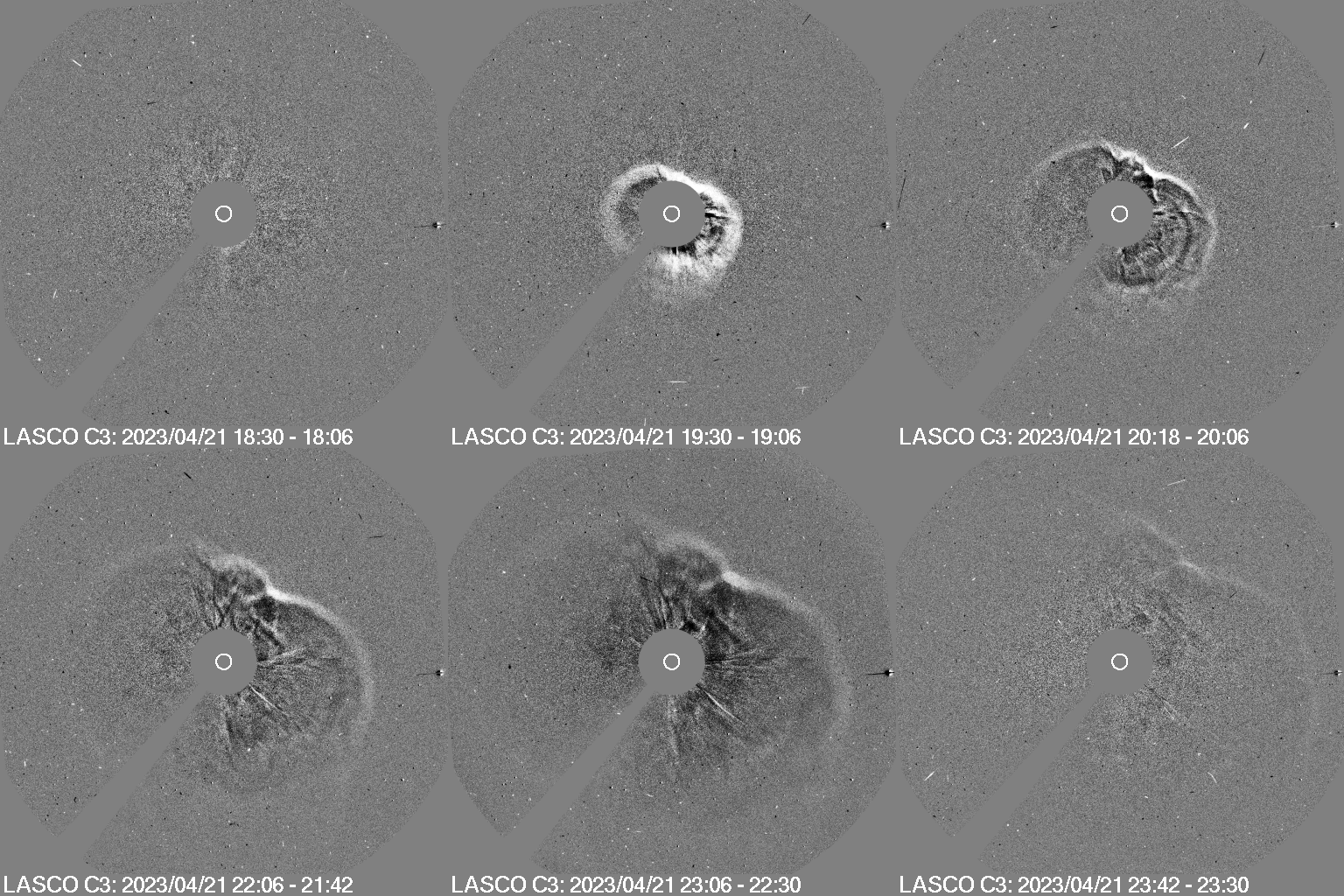
<p>If you ever get a chance to be near Vandenberg or any other spaceport during a scheduled liftoff, be sure to check local viewing locations. There’s nothing quite like witnessing a rocket pierce the sky in real time.</p>]]></content><author><name>Krzysztof Kotysz</name></author><category term="blog" /><category term="astronomy" /><category term="starlink" /><category term="rocket" /><category term="vandenberg" /><category term="spacex" /><category term="goleta" /><summary type="html"><![CDATA[On February 10th, 2025, I had the thrilling opportunity to witness and photograph the Starlink Group 11-10 launch from Space Launch Complex 4E at Vandenberg Space Force Base. This mission carried a batch of 23 satellites into Low Earth Orbit—another milestone in SpaceX’s ever-growing “mega-constellation,” which aims to provide global, space-based internet service.]]></summary></entry><entry><title type="html">Remember remember the 5th of November!</title><link href="https://krzkot.com/blog/astronomy/remember-remember/" rel="alternate" type="text/html" title="Remember remember the 5th of November!" /><published>2023-12-07T23:00:00+01:00</published><updated>2023-12-07T23:00:00+01:00</updated><id>https://krzkot.com/blog/astronomy/remember-remember</id><content type="html" xml:base="https://krzkot.com/blog/astronomy/remember-remember/"><![CDATA[<p>In recent months there has been an increased solar activity with quite a lot of solar flares that resulted in CMEs (Coronal Mass Ejections) that were directed toward Earth. Earlier this year (21st of April) there have been a M1.7 class solar flare on the Sun that resulted in CME - mass ejected from the Sun travelled with velocity over 800km/s after 2 days reached the Earth. This can be seen in an animation from  SOHO/LASCO C3 instrument.</p>

<p><img src="/assets/images/cme_full_halo.gif" alt="SOHO/LASCO C3 differential image of CME after M1.7 solar flare" title="SOHO/LASCO C3 differential image of CME after M1.7 solar flare" /></p>

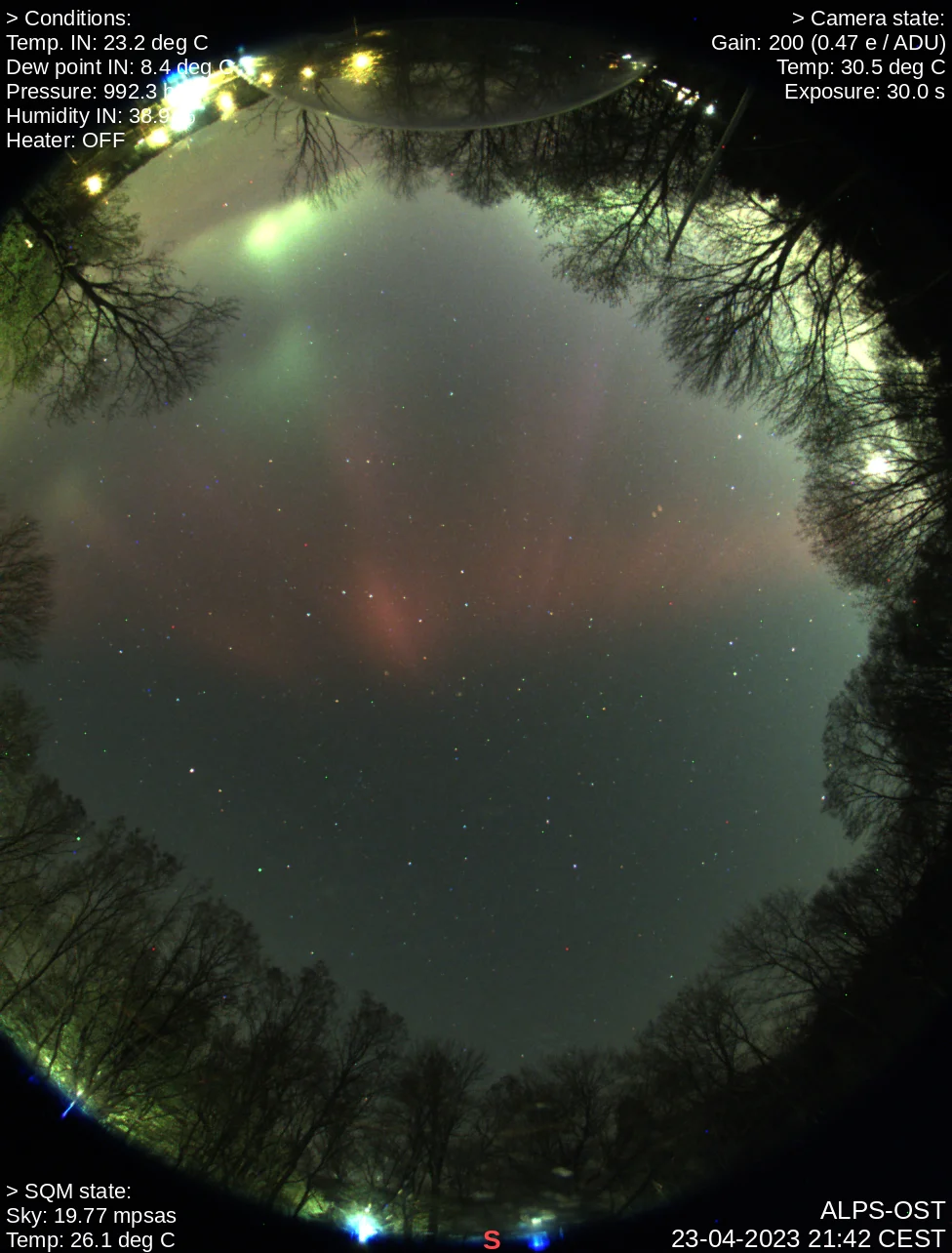
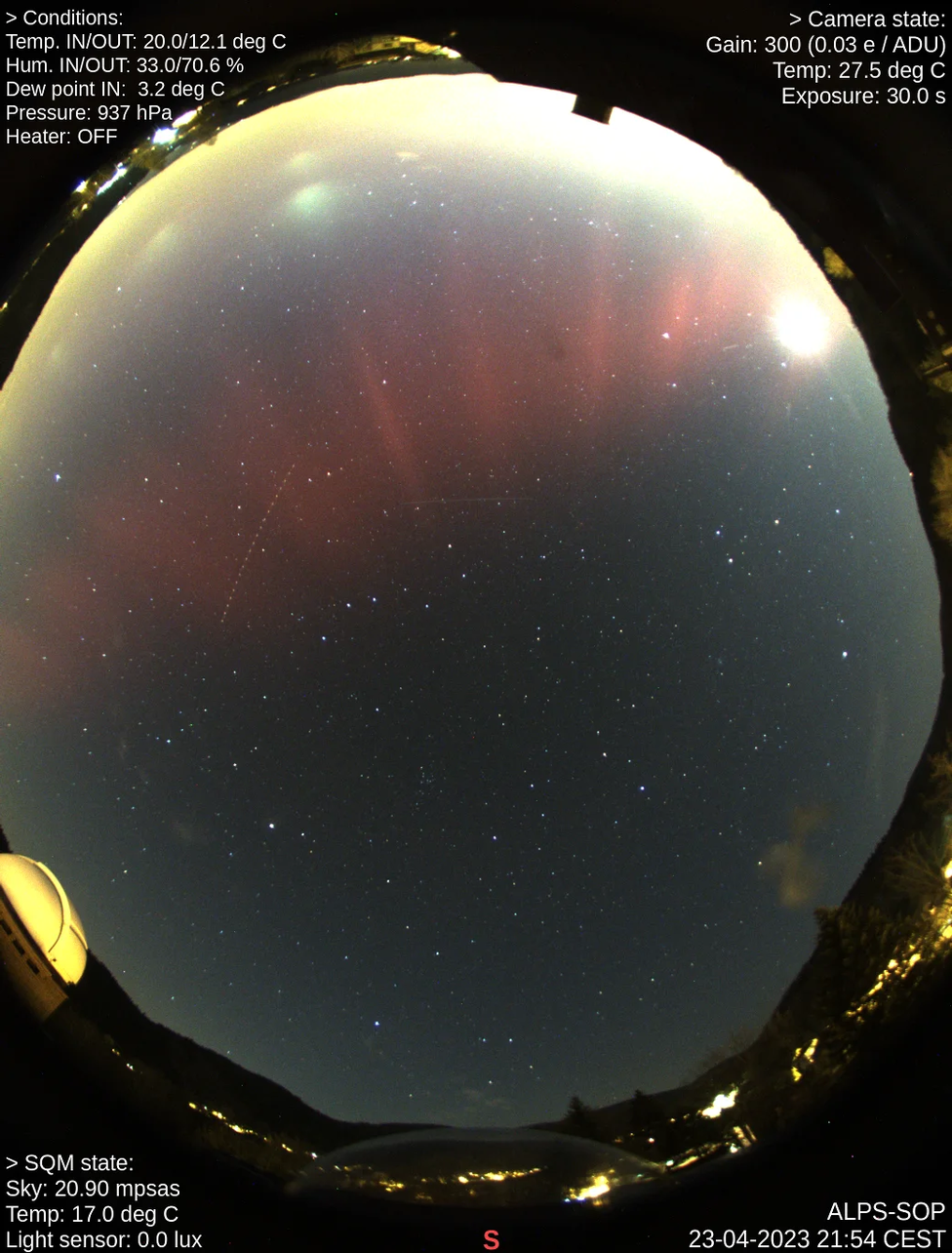
<p>This lead to creation of an extensive aurora oval that could be observed even from southern Europe. In Poland Aurora was visible even in zenith. Thanks to <a target="_blank" href="http://alps.astro.uni.wroc.pl">ALPS</a> (All-sky Light Pollution Survey) - which I am a part of - aurora images were captured bu several of observing stations a.o. Ostrowik (ALPS-OST) and Sopotnia Wielka (ALPS-SOP).</p>
<p float="left" align="middle">
    <a href="/assets/images/alps-ost.png"><img src="/assets/images/alps-ost.png" width="300" /></a>
    <a href="/assets/images/alps-sop.png"><img src="/assets/images/alps-sop.png" width="300" /> </a>
  </p>
<figcaption>Aurora visible over Ostrowik (near Warsaw) and Sopotnia Wielka in Żywiec Beskids.</figcaption>

<p>But that’s not all! Last month on November 5th <img src="/assets/images/guy_fawkes_100px.png" style="height: 1em; display: inline-block;" /></p>
<iframe width="315" height="560" src="https://youtube.com/embed/cWNfCb1RjyI?feature=shared" title="YouTube video player" frameborder="0" allow="accelerometer; autoplay; clipboard-write; encrypted-media; gyroscope; picture-in-picture; web-share" allowfullscreen=""></iframe>]]></content><author><name>Krzysztof Kotysz</name></author><category term="blog" /><category term="astronomy" /><category term="aurora" /><category term="wroclaw" /><category term="alps" /><summary type="html"><![CDATA[In recent months there has been an increased solar activity with quite a lot of solar flares that resulted in CMEs (Coronal Mass Ejections) that were directed toward Earth. Earlier this year (21st of April) there have been a M1.7 class solar flare on the Sun that resulted in CME - mass ejected from the Sun travelled with velocity over 800km/s after 2 days reached the Earth. This can be seen in an animation from SOHO/LASCO C3 instrument.]]></summary></entry><entry><title type="html">The Bright Comet in the Sky</title><link href="https://krzkot.com/blog/astronomy/the-bright-comet-in-the-sky/" rel="alternate" type="text/html" title="The Bright Comet in the Sky" /><published>2020-07-18T15:00:00+02:00</published><updated>2020-07-18T15:00:00+02:00</updated><id>https://krzkot.com/blog/astronomy/the-bright-comet-in-the-sky</id><content type="html" xml:base="https://krzkot.com/blog/astronomy/the-bright-comet-in-the-sky/"><![CDATA[<p>An opportunity to watch a bright comet does not come often. The last one was called <strong>C/1995 O1</strong> or simply <strong>Comet Hale-Bopp</strong>. It was visible to the naked eye for 18 months!</p>

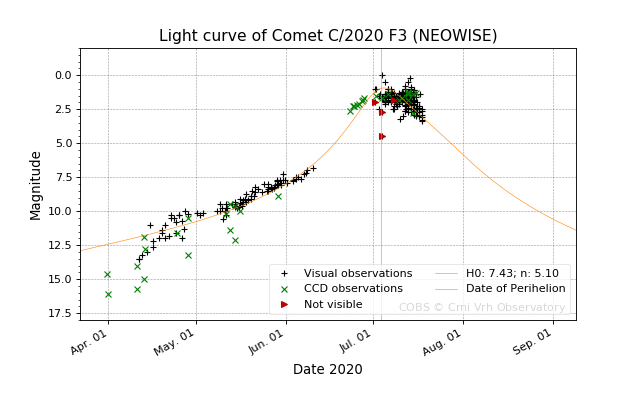
<p>The hero of this post is not as bright as Hale-Bopp but also can be seen by naked eye. <strong>Comet NEOWISE</strong> or <strong>C/2020 F3 (NEOWISE)</strong> is already circumpolar object (in Poland, at the time of writing this post) which means it does not set. It can be seen during whole night over the northern horizon. Comet was discovered March 27, 2020 and two tails (dust and ion) can be seen. The first one by eye and second one in photographs. The nucleus is estimated to be about 5km. As of 16 July brightness was about 2-2.5 mag.</p>

<figure>
    <a href="/assets/images/lightcurve_20200718-120038.png"><img src="/assets/images/lightcurve_20200718-120038.png" /></a>
    <figcaption>Light-curve of C/2020 F3 (NEOWISE) (Jul 18, 2020).<br />Source: <a href="https://cobs.si">COBS/Crni Vrh Observatory</a></figcaption>
</figure>

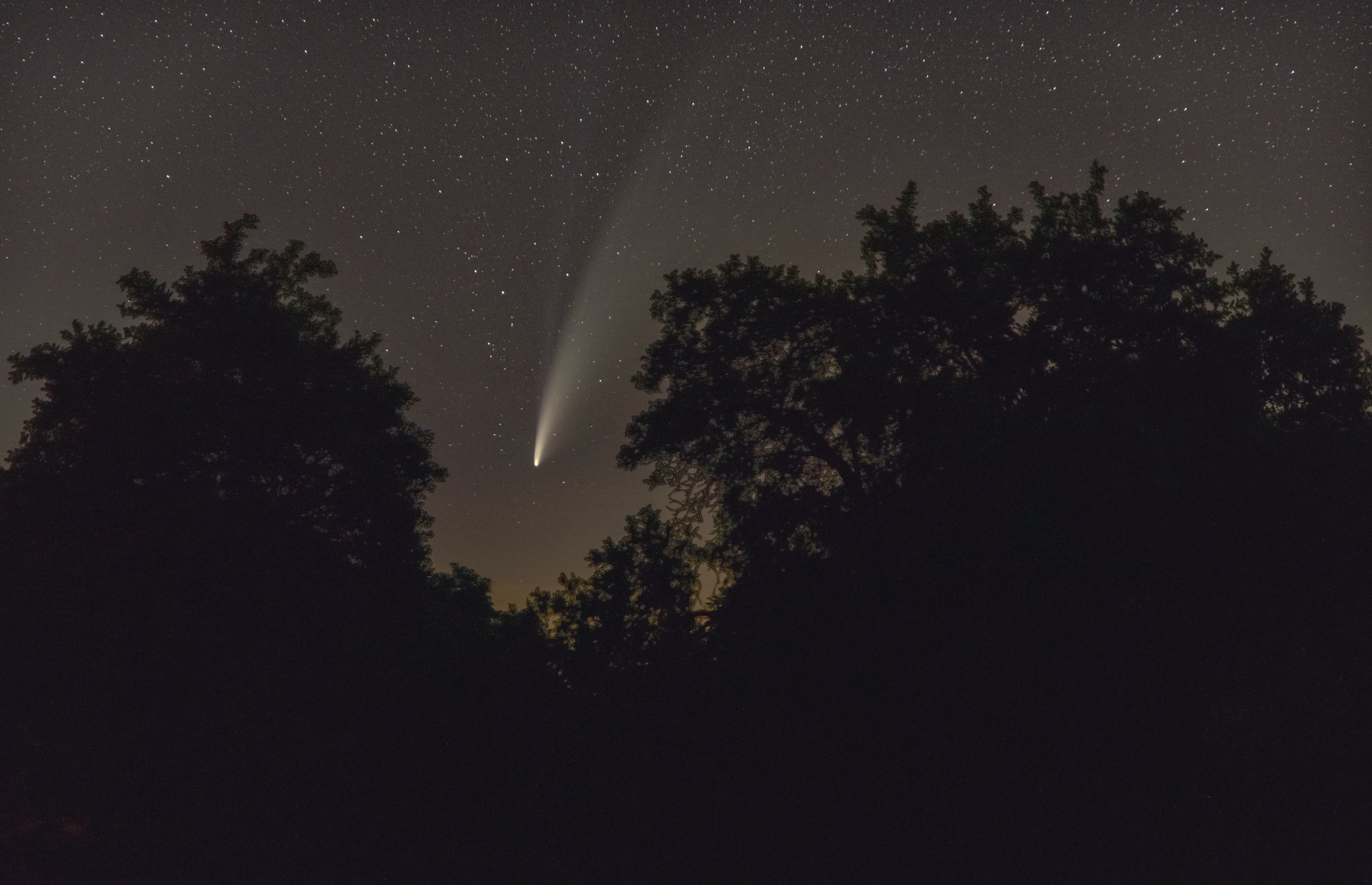
<p>Recently, I had the opportunity to capture <strong>C/2020 F3 (NEOWISE)</strong> at <a href="http://oab.astro.uni.wroc.pl">Bialkow Observatory</a>. Despite the comet’s low altitude, sky in Bialkow is really dark. Along with cloudless nights, conditions for observations were excellent. Below is the photogpraph that I was able to take. Two tails are visible, bright dust one and faint bluish ion tail.</p>
<figure>
    <a href="/assets/photos/2020-07-14_22-29-00.jpg"><img src="/assets/photos/2020-07-14_22-29-00.jpg" alt="Comet C/2020 F3 (NEOWISE) above Białków" /></a>
    <figcaption>C/2020 F3 (NEOWISE) (Jul 14, 2020). Details:
    <li>Camera: Nikon D610</li>
    <li>Lens: Tamron SP 24-70 mm f/2.8 VC USD G2</li>
    <li>Image settings: 9x6s@70mm f/2.8, ISO 6400</li>
    </figcaption>
</figure>

<p>Other photos are present in <a href="/gallery/">gallery</a>. I strongly encourage everyone to see this gorgeous comet. ☄️</p>]]></content><author><name>Krzysztof Kotysz</name></author><category term="blog" /><category term="astronomy" /><category term="comet" /><category term="c/2020" /><category term="f3" /><category term="neowise" /><category term="bialkow" /><summary type="html"><![CDATA[An opportunity to watch a bright comet does not come often. The last one was called C/1995 O1 or simply Comet Hale-Bopp. It was visible to the naked eye for 18 months!]]></summary></entry><entry><title type="html">Welcome to my site!</title><link href="https://krzkot.com/blog/welcome-to-my-site/" rel="alternate" type="text/html" title="Welcome to my site!" /><published>2020-07-18T11:00:00+02:00</published><updated>2020-07-18T11:00:00+02:00</updated><id>https://krzkot.com/blog/welcome-to-my-site</id><content type="html" xml:base="https://krzkot.com/blog/welcome-to-my-site/"><![CDATA[<p>Hi!<br />
This is the start of my personal webpage. I will post here different content - news about astronomy, my work, <code class="language-plaintext highlighter-rouge">python</code> projects and many more (hopefully , we’ll see… :wink:).</p>

<p>In this first post I’d like to write a little about <a href="https://jekyllrb.com/">Jekyll</a> project which I used to create this site. It is a very powerful tool for generation of blog-type static sites. It was written in <a href="https://www.ruby-lang.org/pl/">Ruby</a> programming language by Tom Preston-Werner, GitHub’s co-founder. I strongly recommend to familiariaze yourself with <code class="language-plaintext highlighter-rouge">Jekyll</code>, especially if you want to launch your website using <a href="https://pages.github.com">GitHub Pages</a> - it integrates very well with <code class="language-plaintext highlighter-rouge">Jekyll</code>.</p>

<p><code class="language-plaintext highlighter-rouge">Jekyll</code> offers a very large amount of themes to choose from and most of them are free and customizable (if acknowledgment is provided). The one that I am using is called <a href="https://mademistakes.com/work/minimal-mistakes-jekyll-theme/">Minimal Mistakes</a>. Another advantage is that most of the website development is done in <strong>markdown</strong>. Knowledge of <code class="language-plaintext highlighter-rouge">Ruby</code> language and <code class="language-plaintext highlighter-rouge">html</code> may come in handy if you plan to go beyond what is offered by chosen theme.</p>

<p>To get yourself started I can recommend this great <a href="https://youtu.be/T1itpPvFWHI"><strong>tutorial</strong></a> made by Mike Dane from <a href="https://www.mikedane.com">Giraffe Academy</a>.</p>]]></content><author><name>Krzysztof Kotysz</name></author><category term="blog" /><category term="Jekyll" /><category term="start" /><category term="Ruby" /><category term="GitHub Pages" /><summary type="html"><![CDATA[Hi! This is the start of my personal webpage. I will post here different content - news about astronomy, my work, python projects and many more (hopefully , we’ll see… :wink:).]]></summary></entry></feed>